CENTER STAGE
June 1987
“Backstage.. with Artist Whitney Wolf”
Written By: Louise Gaston
Photo by: J.R. Hosner
Whitney Wolf's work can best be described as the successful blending of art and science. The works artistically reflect the sciences of deep space, physics and quantum reality.
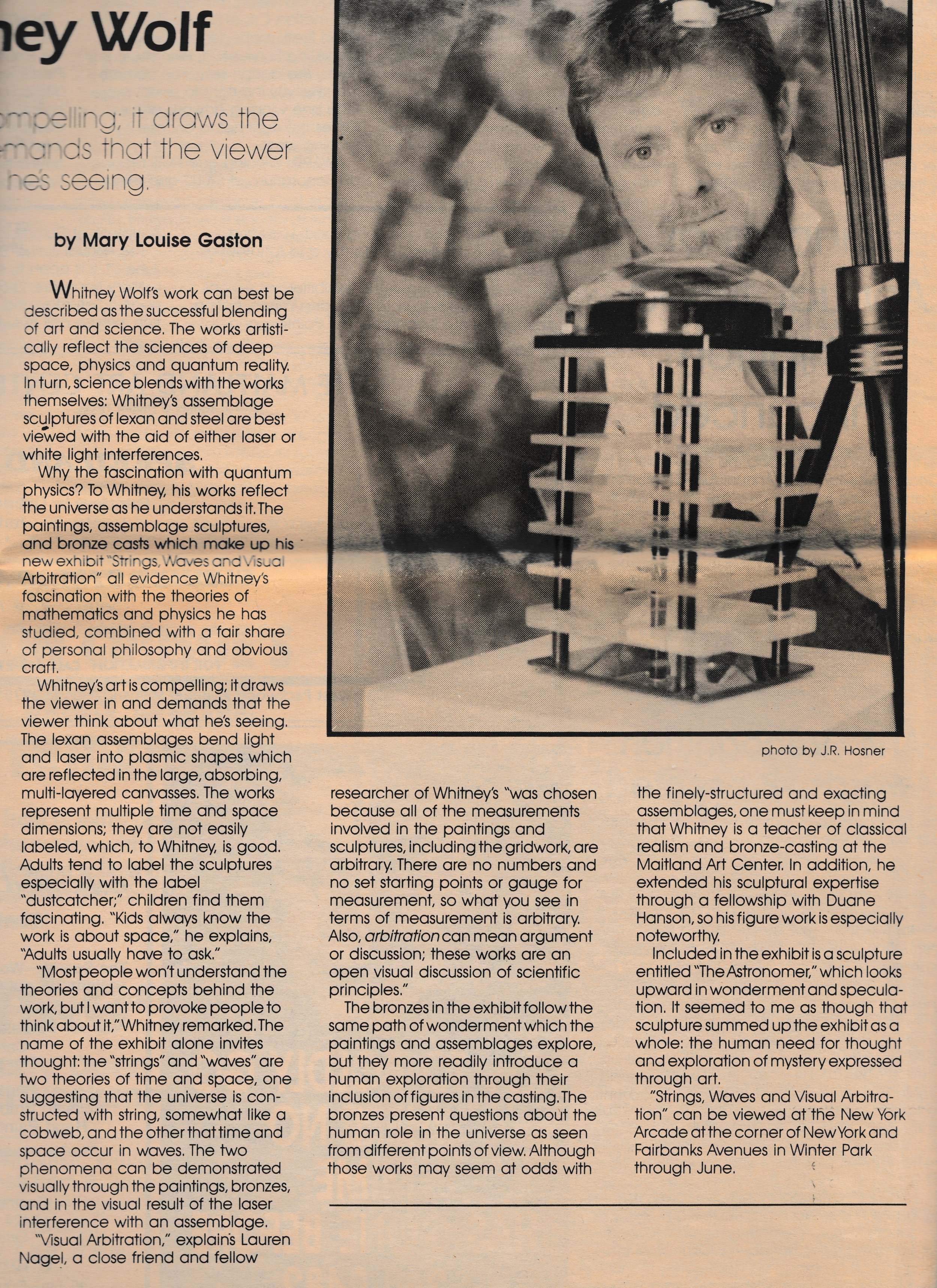
In turn, science blends with the works themselves: Whitney's assemblage sculptures of lexan and steel are best viewed with the aid of either laser or white light interferences.
Why the fascination with quantum physics? To Whitney, his works reflect the universe as he understands it. The paintings, assemblage sculptures, and bronze casts which make up his new exhibit Strings, Waves and Visual Arbitration" all evidence Whitney's fascination with the theories of mathematics and physics he has studied, combined with a fair share of personal philosophy and obvious craft.
Whitney's art is compelling; it draws the viewer in and demands that the viewer think about what he's seeing.
The lexan assemblages bend light and laser into plasmic shapes which are reflected in the large, absorbing, multi-layered canvasses. The works represent multiple time and space dimensions; they are not easily labeled, which, to Whitney, is good.
Adults tend to label the sculptures especially with the label "dustcatcher;" children find them fascinating. "Kids always know the work is about space," he explains, "Adults usually have to ask."
"Most people won't understand the theories and concepts behind the work, but I want to provoke people to think about it," Whitney remarked. The name of the exhibit alone invites thought: the "strings" and "waves" are two theories of time and space, one suggesting that the universe is constructed with string, somewhat like a cobweb, and the other that time and space occur in waves. The two phenomena can be demonstrated visually through the paintings, bronzes, and in the visual result of the laser interference with an assemblage.
"Visual Arbitration," explains Lauren Nagel, a close friend and fellow researcher of Whitney's "was chosen because all of the measurements involved in the paintings and sculptures, including the gridwork, are arbitrary. There are no numbers and no set starting points or gauge for measurement, so what you see in terms of measurement is arbitrary. Also, arbitration can mean argument or discussion; these works are an open visual discussion of scientific principles."
The bronzes in the exhibit follow the same path of wonderment which the paintings and assemblages explore, but they more readily introduce a human exploration through their inclusion of figures in the casting. The bronzes present questions about the human role in the universe as seen from different points of view. Although those works may seem at odds with the finely-structured and exacting assemblages, one must keep in mind that Whitney is a teacher of classical realism and bronze-casting at the Maitland Art Center. In addition, he extended his sculptural expertise through a fellowship with Duane Hanson, so his figure work is especially noteworthy.
Included in the exhibit is a sculpture entitled "The Astronomer," which looks upward in wonderment and speculation. It seemed to me as though that sculpture summed up the exhibit as a whole: the human need for thought and exploration of mystery expressed through art. "Strings, Waves and Visual Arbitration" can be viewed at the New York Arcade at the corner of New York and Fairbanks Avenues in Winter Park through June 1987.